
By Katie Flowers & Caleb Hulbert
Introduction
Natural gas utilities perform many important tasks as a part of their daily operations, and one of the most vital tasks is meter reading. Natural gas meters are the cash registers of the utility, monitoring consumption of the natural gas customer. Monthly meter readings are crucial, as customers depend on their utility to provide accurate bills based on that consumption. Without accurate consumption data in the form of a meter read, utilities would have no revenue. Accurate reads on both the meter, and meter radios that transmit that data, are a win-win situation. Providing accurate billing leads to higher customer satisfaction, fewer dispute calls, and less dispatches for re-reads. Utilities can also learn several important metrics from meter readings, such as being able to analyze the demand for natural gas and usage patterns across their system. This allows the utility to make more informed decisions for demand and conservation planning. But that’s only if the operations of collecting that data are running according to plan.
Natural gas meter reading is far more complex than it appears on the surface. Utilities must coordinate large field teams, navigate unpredictable site conditions, and manage aging infrastructure that isn’t always accessible or easy to read. Manual meter reading adds another layer of difficulty, requiring technicians to physically locate meters that may be buried, obstructed, or situated in hazardous environments, all while ensuring each reading is captured accurately under time pressure. Weather, customer availability, and inconsistent meter technologies—from decades old mechanical dials to modern digital units—further complicate the process and increase training demands. Every reading must then be validated and integrated into billing systems without delay, creating a high-stakes workflow where even small errors can cascade into customer dissatisfaction, revenue loss, or regulatory scrutiny. The result is an operation that demands precision, resilience, and constant adaptation.
Newer technology is now making it possible to collect consumption data in a more efficient way. Two solutions dedicated to simplifying and improving the meter reading process are Automated Meter Reading (AMR) and Advanced Metering Infrastructure (AMI). These two solutions greatly minimize or even eliminate the manual work that field technicians have come to know. With these options, technicians can collect consumption data by walking or driving by meters, or even remotely. For additional information on how much time can be saved by migrating from a manual meter reading process to a drive-by meter reading process, please see our case study linked here. There are additional benefits to these solutions that can provide deeper insights for distribution system modeling, and improvements to other operations such as meter fleet sampling programs, billing operations, customer engagement, and most importantly, the safety of all stakeholders. There have been exciting recent developments that are making AMR and AMI more accessible to small and mid-sized utilities. This includes two new solutions from Sensus, a Xylem brand – FieldLogic™ FlexRead and FlexNet Connect. In this white paper, we will explore these two solutions to help determine which type of meter reading solution fits your business.
For the purposes of this white paper, our discussion is limited to the Sensus FlexRead and FlexNet Connect solutions. Features and functionality of other AMR and AMI systems may differ from what is described here.
Automated Meter Reading (AMR)
The slow process of manually collecting meter consumption data has traditionally required many hours of labor each month. Beyond the physical and time commitment to collect manual reads, utilities can run into other issues, such as difficulties accessing meters on customers’ property, data entry errors, and delayed reporting that results in increased operational expenses. Having to routinely deal with these issues can put strain on a utility by eating up valuable time and resources, especially when there’s growing pressure on smaller utilities to do more with less.
With all this in mind, most utility operators have already made the decision to move beyond manual meter reads. An automated meter reading (AMR) solution uses radio frequency technology that transmits data from a meter radio to a mobile collector, which is either a hand-held device or a collector that is mounted in a vehicle. There are two methods for collecting data: a walk-by solution or a drive-by solution. Once the data is collected by the AMR solution, it is then processed, reviewed, and loaded into the billing platform, or CIS for bill generation and data analysis. One such AMR option is the FieldLogic™ FlexRead solution from Sensus.
Sensus FieldLogic™ FlexRead Solution
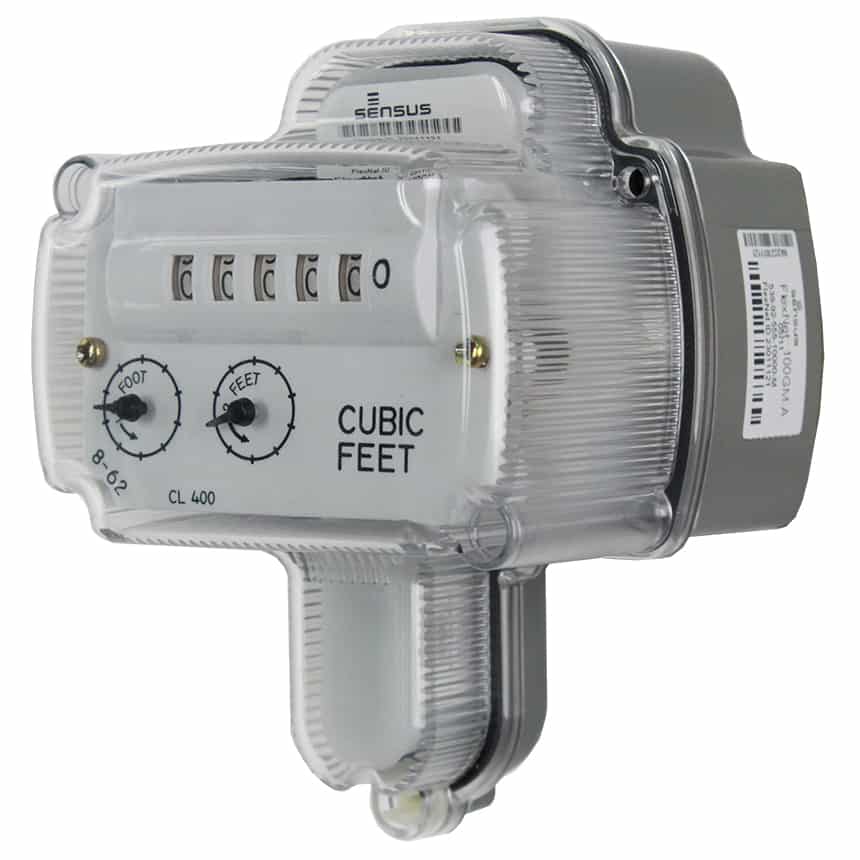 Sensus developed FieldLogic™ FlexRead to provide natural gas utilities with a more flexible way to read meters as the industry and its needs change. FlexRead is a cloud-based platform, which makes it quick to deploy and easy to use. With this solution, a utility can choose either a walk-by or drive-by method depending on its needs. If migrating from a manual read system and deploying only Sensus meter radios, called SmartPoints, a walk-by or drive-by solution is available. However, one of the best benefits of all is that the FlexRead AMR solution can read meter radios from multiple manufacturers. Not only does the system read Sensus SmartPoints®, but it is also able to simultaneously read Itron ERTs and Neptune R900s with the drive-by functionality of the solution. Old radios still often still have capital value tied to them, so with FlexRead there is no need to rip and replace radio hardware to transition to a more advanced meter reading technology. The simple meter reading setup doesn’t require a heavy technical lift; all you need is the FieldLogic Cloud application running on an Android or Apple device, a FlexRead Vehicle Transceiver (such as an EasyLink Reader), and vehicle antenna(s) with magnetic mount.
The meter reader’s routes are uploaded into FieldLogic Cloud and sent directly to their devices via a cloud connection. The platform gives near real-time data via a cellular, or WiFi connection of where technicians are located in the service territory and progress of their meter reading activities, allowing management to easily track completion status of the routes. If an emergency occurs, remaining meters in a route can be assigned to an alternative reader to complete meter reading operations. Once all meters have been read on the route, or the route is marked as closed, the data is quickly and accurately exported to the billing software.
Like any industry, natural gas utilities face their fair share of challenges, or pain points. Sensus developed FlexRead to address some of the most pressing items.
- Aging Infrastructure: It’s no secret; updating infrastructure is not something done overnight... or all that quickly in general. Utilities want to try to maximize the use of the older meters and endpoints already in the system. But equipment, especially battery powered radios, can only last for so long.
- Regulatory Concerns: There is an increased emphasis on safety, compliance, and environmental demands from governing bodies and consumers. These require timely and accurate data.
- Limited Budgets: Utilities are facing increasing operational costs with little wiggle room in their budget. Many smaller utilities just don't have the funds to do a wholesale product replacement or implement a large, automated solution.
- Customer Expectations: Utility customers expect their bills to be accurate each month and have their disputes resolved quickly.
The Benefits of the FlexRead Solution
Utilities don’t need a big budget to implement an AMR solution. FlexRead is a simple, cost-effective solution for utilities of all sizes, including those smaller utilities that have hesitated to deploy based on capital concerns in the past. When migrating from an existing AMR solution, FlexRead operates similar to the AMR solution that the utility is already using, minimizing adoption timelines. FlexRead does however provide the user with a more elevated, simplified interface compared to antiquated systems. FlexRead allows a utility to seamlessly map and manage technician routes, cutting down manual busy work to make better use of time and resources. It’s so simple to implement that billing integrations and solution training can often be completed in just a few days, minimizing downtime and disruption for customers.
As for the previously mentioned pain points, FlexRead can be part of the fix. In most cases, there isn’t a need to rip-and-replace all existing meter reading infrastructure. Utilities can start using FlexRead with its existing current meter and radio hardware and can save the capital value tied to the existing meter radios. Combined with smart gas meters, such as the Sensus Sonix IQ, FlexRead provides better accountability of company resources. The simplified, easy-to-use interface helps utility billing personnel manage and process consumption data more efficiently. Utilities can improve customer experience thanks to faster and more accurate meter readings, with far fewer estimates. And if the needs change one day, or a utility wants better insight into distribution system assets, that’s no problem. FlexRead makes it easy to transition to Sensus’s Automated Metering Infrastructure, FlexNet.
Advanced Metering Infrastructure (AMI)
While the natural gas industry is not traditionally known for adapting to change swiftly, there are still exciting developments being made. One such utility solution that is making big waves in the industry is Advanced Metering Infrastructure.
Advanced Metering Infrastructure (AMI) is an integrated system of smart meters, smart sensors, and data management systems under a network umbrella, that enables communication between a utility and its deployed assets. The system operates on a radio frequency network, similar to a cell phone connection, or SCADA solution. There are a few standard networks available for AMI networks: cellular, mesh, and point-to-multipoint (read more about the different network types in our previous white paper). The AMI network transmits consumption readings from smart meters or other endpoints back to the utility for analysis. The network can also incorporate sensors that measure important field conditions such as pressure, remotely shut off gas service, monitor corrosion, and more. Collecting essential data is easier than ever with its remote capabilities. This data can then be shared with appropriate stakeholders, such as billing clerks, pertinent operations personnel, or even a utility customer.
Sensus FlexNet Connect
Built with the backbone of Sensus’s leading FlexNet AMI communication network, FlexNet Connect is a new budget-friendly, rapidly deployable option for utilities looking to improve legacy meter reading operations. AMI solutions have traditionally required a large capital investment that would price small utilities out of the market, but the FlexNet Connect solution was built with gas utilities that operate fewer than 3,000 service connections. Like the original FlexNet, FlexNet Connect is built on a private radio network. Having a private, dedicated frequency provides the utility with industry leading transmission range, and secure reliability. The licensed spectrum also offers low noise and high signal penetration. The network management user interface keeps appropriate personnel informed with real-time data and alerts for leaks, pressure anomalies, tamper, and countless other distribution system insights. If you’re looking to manage assets more efficiently and gain insights into your distribution system’s performance, Sensus offers an impressive software combination that includes the Regional Network Interface (RNI), Sensus Analytics, and Xylem Data Lake. The RNI is the “head end” or “user interface” that aggregates all data associated with the FlexNet network. Sensus Analytics is a data management software that incorporates billing data from the utility’s CIS/Billing system, along with RNI data for easy analysis and billing processes. Xylem Data Lake is a robust database that can include data from multiple sources including the CIS, RNI, GIS, WOMS, etc. This was built to be an all-inclusive data repository that can be easily queried through simple questions, much like an AI language model such as ChatGPT or Claude.
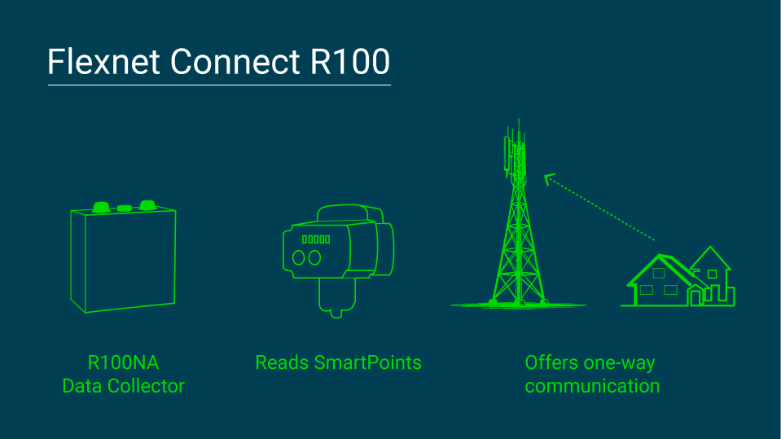
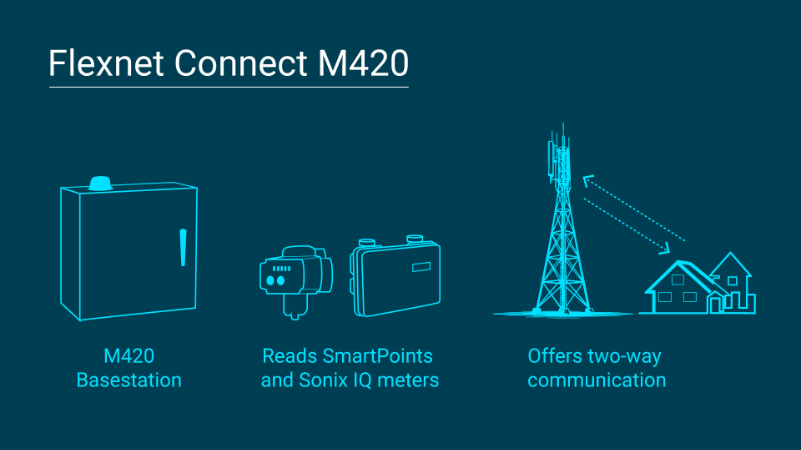
FlexNet Connect enables utilities to deploy an AMI solution at a scale that works best for its operational and capital allocations. There are two deployment options available for this solution that can include either the R100 or M420. The R100 and M420 are the data collectors that are typically installed with antennas attuned to the utility’s private, assigned frequency on a tall vertical asset such as a RF tower or wooden pole. The M420 is the larger, more powerful option of the two with over 25W of output power. It has further reach, or downlink, to the radio assets in the network, resulting in a larger network coverage area. The R100 is the smaller version of the M420 with only 2W of output power, but a more budget-friendly option. Either can be a viable option depending on the size of the service area of the utility.
FlexNet Connect R100
- Requires the R100NA Data Collector and Sensus SmartPoints
- Built for reliable, over-the-air (OTA) meter reading and field sensor backhaul for a small geographic service area
- Reads up to 3,000 SmartPoints with secure, reliable communication
FlexNet Connect M420
- Requires M420 base station, SmartPoints, and/or Sonix IQ meters
- Offers robust two-way communication and valve control
- Supports up to 3,000 Sensus SmartPoints and Sonix IQ meters
- Perfect if you want to control your meters remotely
Benefits of FlexNet Connect
An AMI solution such as FlexNet Connect allows a utility to do so much more with less operational strain. When compared to the traditional Sensus FlexNet AMI solution, FlexNet Connect is faster to deploy, simpler to integrate and manage, and most importantly, more affordable. It fits right into the sweet spot for those smaller utilities looking for better network connectivity without blowing the budget.
A traditional AMI project is often a long cycle from initial interest to completed deployment. With FlexNet Connect, an AMI system can be up and running in weeks, instead of months or years. It can be done with minimal disruption to customers and operations, and no network coverage study is required. Utilities still get the same security and dependability as they would with the standard FlexNet solution’s private, dedicated, utility network. More accurate and timely consumption data improves billing operations, reduces truck rolls for re-reads, and detects distribution system anomalies such as elevated pressure making it a win-win for the utility, and its customers.
Conclusion: Which Solution is Right for You?
Decisions, decisions. Both automated meter reading (AMR) and advanced metering infrastructure (AMI) bring an array of benefits to make manual meter reading a thing of the past. FlexRead is a full feature AMR solution, and FlexNet Connect is a more budget friendly option of the established FlexNet services. Both can be implemented in a matter of weeks or months but vary in scale and capabilities. Whichever solution is chosen, expect to be able to provide better customer service with faster consumption data collection and more accurate billing. With help from Holland Supply’s experienced Smart Gas team, a utility can easily determine which option is the best for their unique situation.
If the focus is solely on improving consumption data collection and limited frills, then the FlexRead AMR solution would be a perfect fit. It’s a budget-friendly single solution that allows utilities to read meters more efficiently and can even collect that consumption data from competitive manufacturers’ radios if an AMR solution is already in place. Data loss, or corrupted read files are no longer an issue as the field collection platform automatically syncs all reads to the cloud, allowing billing or customer service to access that information even sooner.
If over the air (OTA) meter reading with no need for meter readers is the utility’s goal, FlexNet Connects offers flexibility in two deployment options through the R100 and M420 data collectors. Both options provide secure network service on a private radio frequency with the option of end-to-end encryption. If meter valve control is something your utility is interested in, the FlexNet Connect M420 option allows specific utility personnel to remotely control Sonix IQ meters. Not only does FlexNet Connect improve data accuracy, but it also helps the utility reduce truck rolls and potentially prevent dangerous incidents.
As utilities evaluate the path toward AMR or AMI modernization, selecting the right partner is essential to achieving a smooth and successful transition. Holland Supply is committed to supporting utilities of all sizes in identifying the solution that best aligns with their operational needs and long-term strategy. Once a technology direction is chosen, our Smart Gas team provides comprehensive on-site and remote support throughout implementation, deployment, and ongoing operations. With this partnership-driven approach, utilities can move forward with confidence as they modernize their metering infrastructure and enhance service delivery.